
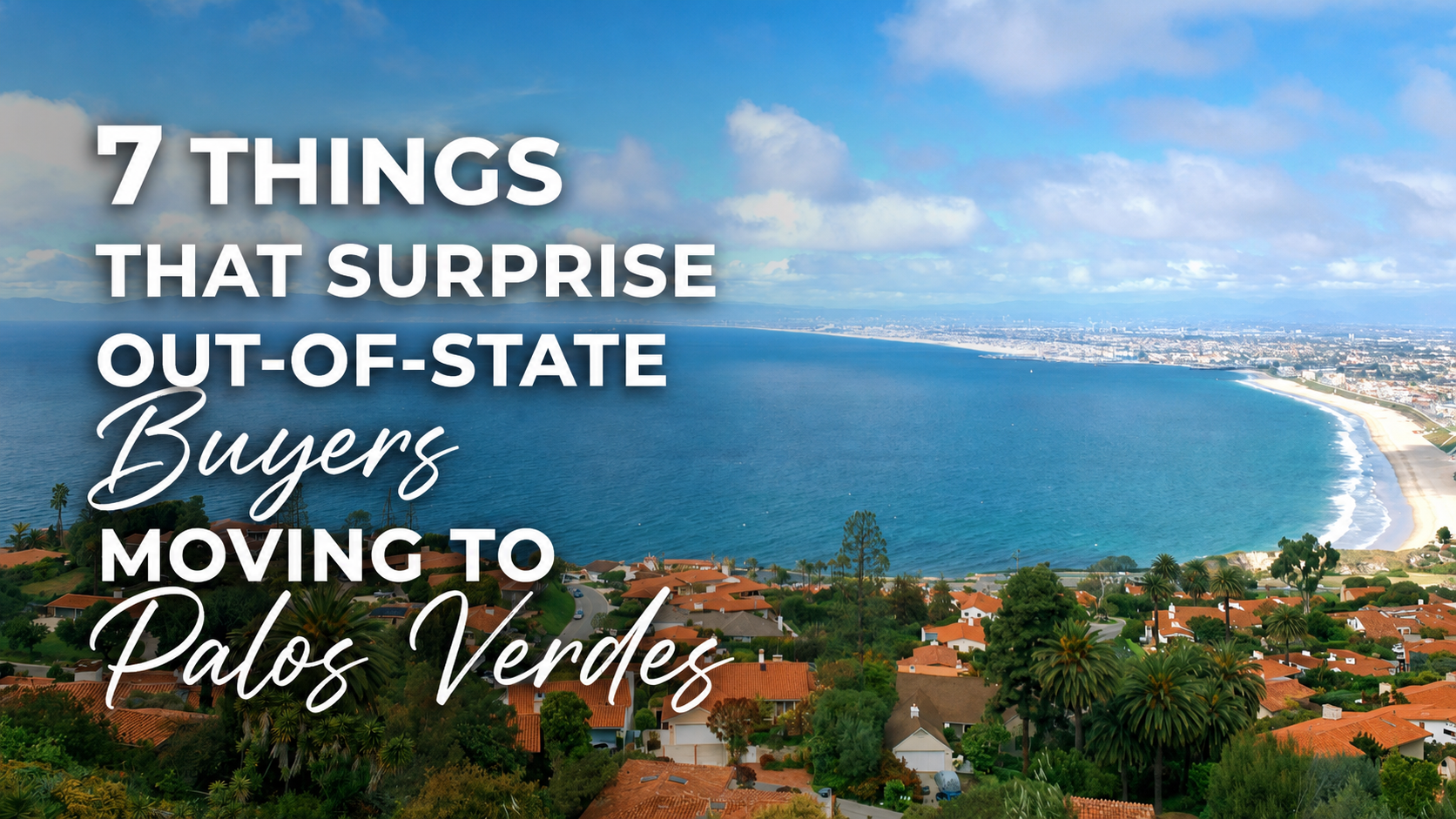
If you’re moving to Palos Verdes from another state, buying a home here may work differently than what you’re used to—and there are a few things you’ll want to know before you make an offer.
I work with buyers moving to Palos Verdes Estates and the Palos Verdes Peninsula, and many are coming from places like New York, Texas, Chicago, Seattle, Boston, Idaho, or even Northern California.
The homes may be what initially bring you here, but California has its own way of handling real estate—and Palos Verdes has a few quirks of its own.
Here are seven things that often surprise out-of-state buyers.
1. California Closings Work Differently
If you’re accustomed to attorneys handling a real estate closing, California may feel very different.
Most residential transactions here are handled primarily through escrow and title, rather than attorneys sitting around a closing table.
A neutral escrow company coordinates the closing process with the buyer, seller, lender, title company, and real estate agents.
California purchase agreements also have specific timelines for inspections, financing, appraisal, disclosures, and other contingencies.
None of this is particularly complicated once you understand it. But you want to understand how the process works before you write an offer, not while the clock is already running.
2. California Has a Lot of Disclosures
California is a disclosure-heavy state, and Palos Verdes is an area where you should actually read them.
Buyers typically receive a substantial disclosure package that can include the Seller’s Transfer Disclosure Statement, Natural Hazard Disclosure information, inspection reports, and other property-specific documents.
When you’re buying on the Palos Verdes Peninsula, those disclosures can be especially important.
Geology, drainage, previous improvements, permits, property condition, natural hazards, and other issues can vary considerably from one property to another.
The goal isn't to find reasons to be afraid of a house. It’s to understand exactly what you're buying.
3. Your Property Taxes Will Change After You Buy
One of the easiest mistakes to make is looking at what the current owner pays in property taxes and assuming your bill will be similar.
It probably won't be.
When a California property changes ownership, it is generally reassessed based on the new purchase.
There can also be a supplemental property tax bill after closing reflecting the difference between the property's previous assessed value and its new assessed value.
That bill may arrive months after you buy the home.
If you know it's coming, it's simply something you budget for. If you don't, it can be an unpleasant surprise.
4. Remodeling in Palos Verdes Estates Has Its Own Rules
If you're buying a Palos Verdes Estates home with plans to remodel, expand, or substantially change the exterior, investigate what you can do before you buy it.
Palos Verdes Estates has architectural oversight through the Palos Verdes Homes Association and Art Jury, in addition to applicable city requirements.
Exterior changes, additions, and other improvements may require architectural review and approval.
That doesn't mean you can't remodel a home in Palos Verdes Estates. People do it all the time.
It does mean you shouldn't buy a property assuming that everything you're envisioning will automatically be approved—or approved on the timeline you have in mind.
If remodeling is an important part of your purchase, that's something we want to investigate before you make the offer.
5. Geology Matters on the Palos Verdes Peninsula
Two properties that don't look very far apart on a map can have very different geological considerations.
This is where it's important to distinguish Palos Verdes Estates from the larger Palos Verdes Peninsula.
Certain portions of the Peninsula have geological and landslide-related conditions and restrictions, with some of the most significant current issues affecting a portion of Rancho Palos Verdes.
That can matter when you're considering remodeling, expanding, rebuilding, or even deciding whether a particular property is right for you.
Don't assume that because something applies to one part of Palos Verdes, it applies everywhere.
When we're looking at a property, we want to understand the issues affecting that specific property.
6. Palos Verdes Estates Neighborhoods Are Very Different From One Another
Looking at Palos Verdes Estates on a map doesn't tell you nearly enough about where you'll actually want to live.
Valmonte, Malaga Cove, Monte Malaga, and Lunada Bay are all within Palos Verdes Estates, but they don't offer exactly the same experience.
The homes, lots, topography, views, proximity to the coast, neighborhood setting, and overall feel can change considerably depending on where you are.
That's one reason I encourage relocating buyers to spend some time actually exploring the different neighborhoods rather than choosing an area entirely from listings online.
You may immediately know where you belong once you've driven the neighborhoods.
Or you may decide to rent first, learn the area, and buy later.
Either approach can make sense.
If schools are an important part of your move, you'll also want to verify the current school assignment for the specific property you're considering rather than making assumptions based solely on the neighborhood name.
7. The House You Love May Not Work for What You Want to Do With It
This may be the most important one if you're buying a property with plans to substantially change it.
It's easy to walk into a house and think:
We'll add another bedroom.
We'll expand the kitchen.
We'll build out the second floor.
We'll change the exterior.
Maybe you can.
But before paying several million dollars for a property based partly on what you believe it can become, you want to understand what's actually possible.
Architectural review, city requirements, view considerations, geology, lot characteristics, and property-specific restrictions can all affect a future project.
Buy the house based on what it is—and investigate carefully before placing significant value on what you think it could become.
This may be the most important one if you're buying a property with plans to substantially change it.
It's easy to walk into a house and think:
We'll add another bedroom.
We'll expand the kitchen.
We'll build out the second floor.
We'll change the exterior.
Maybe you can.
But before paying several million dollars for a property based partly on what you believe it can become, you want to understand what's actually possible.
Architectural review, city requirements, view considerations, geology, lot characteristics, and property-specific restrictions can all affect a future project.
Buy the house based on what it is—and investigate carefully before placing significant value on what you think it could become.
A Few Other California Differences to Know
Earthquake insurance is another issue that often comes up with buyers relocating to California.
Earthquake coverage is generally separate from a standard homeowners insurance policy and is optional for most homeowners. Whether it makes sense for you depends on your circumstances, coverage options, deductibles, and comfort with the risk.
If you're considering a condominium or townhome, you'll also want to look carefully at the HOA's monthly dues, reserves, rules, insurance, and any property-specific assessments or requirements.
These aren't reasons not to buy. They're simply things you want to understand before you do.
Moving to Palos Verdes From Another State?
Buying here doesn't need to be complicated. You just need to understand how California real estate works and which Palos Verdes issues matter for the particular home you're considering.
That's a big part of what I do for relocating buyers translate the process you're accustomed to into how things actually work here in California and Palos Verdes.
Whether you're ready to come out and start looking at homes now or you're considering renting first and learning the neighborhoods, I'm happy to help.
And if you have a home to sell in another state before moving to Palos Verdes, I can connect you with a strong real estate agent through my nationwide referral network and help coordinate that side of your move as well.
I'm Ian Rusnell, and I provide trusted service and results from the start, through closing day, and long after.
Visit RusnellRealEstate.com to learn more about buying a home or relocating to Palos Verdes.
Check out this article next